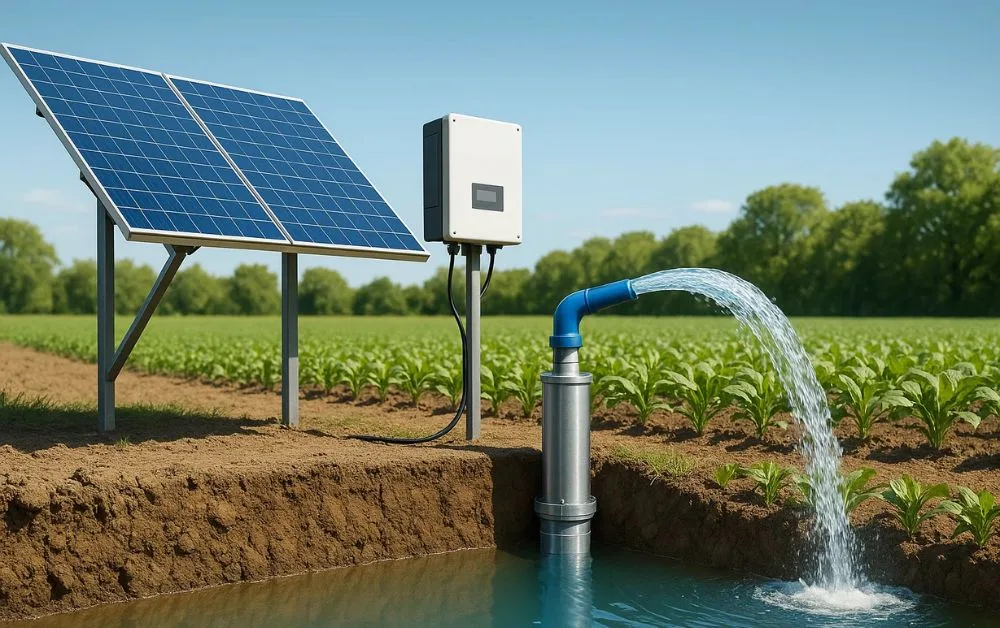
Solar Water Pumping Systems have become one of the most impactful and widely adopted technologies available for Tanzania’s agricultural and rural water supply sectors, providing reliable, fuel-free pumped water from boreholes and surface water sources in locations where grid power is absent and diesel fuel supply is costly, logistically challenging, or operationally unreliable. Understanding how to correctly specify and procure a solar pumping system is essential for any Tanzania operator, farmer, or rural water supply project seeking to maximise the technology’s considerable potential benefits.

System Principles and Performance
A solar water pumping system consists of solar panels generating direct current electricity from sunlight, a pump controller or variable frequency drive that converts this DC power to the form required by the pump motor, and a submersible or surface-mounted pump that lifts water from the source to the storage tank, irrigation system, or distribution network. As solar irradiance increases through the morning hours, the controller progressively increases power delivery to the pump, raising pump speed and water delivery rate proportionally. At peak solar radiation — typically between 10 am and 2 pm in Tanzania — the system operates at its maximum daily flow rate. As irradiance declines in the afternoon, flow rate reduces smoothly and the system stops automatically when radiation falls below the minimum threshold required for pump operation. This automatic variable-speed, sun-following operation requires no manual intervention, delivers the maximum daily water yield achievable from the available solar resource, and imposes essentially no operational burden on farmers or water supply scheme managers who may have limited technical experience.
Agricultural Irrigation: Transforming Tanzania Farming Economics
For Tanzania smallholder and commercial farmers, the most significant impact of solar pumping adoption is the ability to irrigate reliably and affordably during the long dry seasons that previously forced multi-month periods of zero agricultural productivity. A correctly sized solar pumping system delivering 50 to 200 cubic metres of water per day can irrigate one to five hectares of vegetables, fruits, or cash crops during Tanzania’s dry season, generating income streams that were previously impossible to achieve. The complete elimination of diesel fuel cost — historically the single largest and most volatile operating expense for irrigated agriculture schemes — transforms the economic model of irrigated farming in Tanzania, making it viable for smallholders who previously could not manage the fuel cost volatility that diesel irrigation created.
Related read:-What Are the Environmental Benefits of Using Solar Water Pumping Systems?
Rural Water Supply: A Sustainable Solution
Solar pumping systems are increasingly the technology of choice for rural water supply infrastructure development across Tanzania — serving villages, health facilities, schools, and livestock watering points from boreholes in the vast areas of the country without grid electricity. Tanzania’s rural water supply programmes, supported by government and development partners, have deployed hundreds of solar water pumping systems that provide consistent, clean water access to communities previously dependent on shallow wells, seasonal surface sources, or distant collection points. The operational sustainability advantage of solar versus hand pump alternatives — higher daily yield, reduced physical burden on women and girls who typically carry water collection responsibilities, and potential for metered water supply systems that generate revenue to fund system maintenance — makes solar pumping the more sustainable long-term water supply solution in most Tanzania rural contexts.

Correct Sizing Is Everything
The single most common cause of solar water pumping underperformance in Tanzania is incorrect system sizing — specifically, under-specifying solar panel capacity for the actual head and flow requirements of the application, resulting in insufficient daily water delivery during the dry season when irrigation demand is highest and solar radiation is most variable. Correct sizing requires: accurate measurement of total dynamic head including static lift, seasonal water table variation, and pipe friction losses; accurate assessment of daily water volume requirements accounting for irrigation crop water demand, livestock requirements, or domestic consumption; site-specific solar resource data accounting for seasonal variation and any shading; and appropriate battery or storage tank capacity to buffer supply during cloudy periods. Working with experienced Tanzania solar water pumping system suppliers who conduct proper site assessments and provide hydraulic design calculations before system specification protects the investment and ensures the system delivers its intended performance reliably year-round.
Leave a Reply